
Loose Parts as an Activator of Learning in the Early Years
By Debi Keyte-Hartland MA: CollectiveED Fellow
Artist-educator and pedagogical consultant in early years.
On my return from my first visit to Reggio Emilia, Italy, many years ago, I began to evaluate, in the sense of giving value to something, the aspects of my practice that I wanted to think more deeply about.
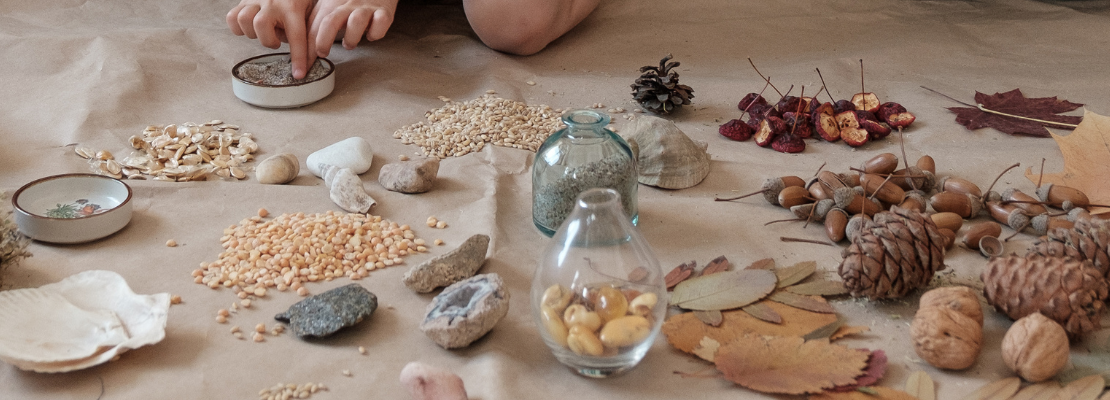
I started revisiting the familiar materials I had previously worked with, like loose parts, to explore how children interacted with them when presented in various ways.
I used to focus on making materials accessible and available to children, but I hadn’t considered how organising and presenting those materials could help them build understanding and share what they learn.
I found myself thinking more about:
The qualities, affordances and properties of the materials
The transformative, expressive and communicative potential (intelligences) of these materials
The dialogues these materials could propose with concepts and intentions for learning
The agency of these materials and what these materials provoked and evoked in children (how they acted on the children)
Materials as a Medium for Expression and Understanding
Cuffaro (1995) reminds us that materials in the hands of children are akin to tools, which give form to and express their meaning-making and knowledge about the world.
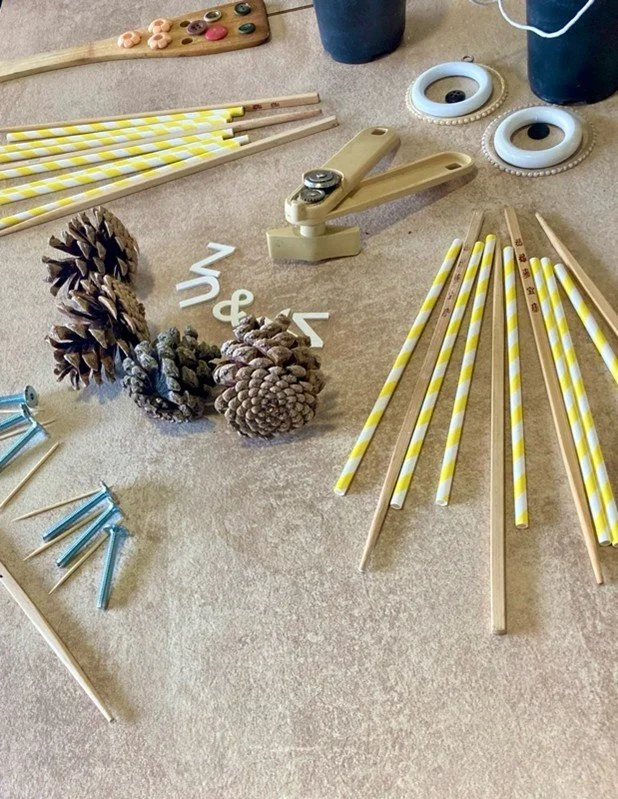
Image: © Debi Keyte-Hartland. Materials awaiting educators at a professional learning day in Brighton.
Young children come to know the world not just through spoken or written language but also through the languages of materials such as clay, paint and loose parts as capable of expressing and communicating their emotions, ideas, working theories and thoughts.
In this sense, materials become a powerful medium for children to articulate their understanding, fostering creativity and deeper engagement with their environment.
The act of manipulating any materials or materials like loose parts encourages children to explore and represent complex concepts, often revealing insights that might remain hidden in traditional forms of communication.
Part of the role of the educator in this context is to develop aesthetically rich environments, materials and contexts ripe for elaboration and contemplation, for making connections, communicating values and making ways of knowing perceptible.
So, I considered how this required us as educators to:
Pay closer attention to how our choices of which materials connected with and met the ideas and experiences of the children
Intentionally consider the variety of ways to propose and present materials like loose parts to activate children’s communication and expression of their learning
Give thought to which materials might be richer in potential, and that enabled children to give form to their thinking and meaning-making
Aesthetics: From Decoration to Deep Learning
Previously, I believed that aesthetics in early childhood education was merely about creating visually appealing and attractive spaces. However, Vea Vecchi, a Reggio Emilia Atelierista, suggests that aesthetics goes far beyond appearances, acting as a catalyst for learning itself (Vecchi, 2010).

Image: © Debi Keyte-Hartland. Children exploring loose parts and light at Ashmore Park Nursery School, Wolverhampton.
As educators, this means we must develop and nurture environments for babies, toddlers, and young children that encourage them to represent, communicate, and express their ideas using a variety of mediums and symbolic languages.
The educator’s role, therefore, is to employ aesthetics in their organising and designing of learning spaces in ways that go beyond just looking nice to a position that enables children to form connections, articulate their discoveries, and share their knowledge and feelings.
[Aesthetics] is a process of empathy relating the Self to things and things to each other. It is like a slim thread or aspiration to quality that makes us choose one word over another, the same for a colour or shade, a certain piece of music, a mathematical formula or the taste of a food. It is an attitude of care and attention for the things we do, a desire for meaning; it is curiosity and wonder; it's the opposite of indifference and carelessness, of conformity, of absence of participation and feeling."(Vecchi, 2010: 5).
Aesthetics can promote learning with loose parts by:
Looking at materials differently – what else could they be or become
Connecting one thing to another and linking concepts or ideas
Enabling children to express their ideas through different forms
Bridging emotional, sensory, rational, and cognitive responses to what children experience and encounter
The aesthetic aspect of working with loose parts or any material can be understood as fostering empathy and building connections among people, children, objects, materials, environments, and places, in every possible way.
According to Vecchi, aesthetics can be understood as a cognitive process that facilitates learning by enabling babies, toddlers and young children to recognise connections and relationships among these various elements.
She contends that, since learning itself involves forming new connections, then aesthetics should be regarded as an "activator of learning" (Vecchi, 2010: 9).
Loose Parts as Catalysts for Exploration and Discovery
Nicholson (1971), a British architect and designer, coined the term loose parts and expanded the concept beyond open-ended materials to include variables like music, gravity, words, concepts, and ideas (Robinson, 2017).
Nicholson believed creativity is inherent in all children. He stressed the importance of environments that support exploration and discovery, encouraging educators to nurture curiosity by providing materials or variables for children to investigate and create with (Nicholson, 1971).
In Reggio Emilia, the REMIDA project collects recycled materials from companies and integrates them into educational settings in the area, emphasising sustainability and creativity. These materials are seen not as waste, but as resources with creative potential that can be transformed by children.

Image: © Debi Keyte-Hartland. Dave the snail made by children at Ashmore Park Nursery School, Wolverhampton.
The approach encourages dialogues with materials where children interact with a wide variety of objects and open-ended materials and variables to explore concepts like symmetry, identity, growth, shape or friendship.
Daly & Beloglovsky (2015) describe loose parts as versatile materials and as objects that children can move, combine, redesign, and manipulate. Educators now see them as essential for learning, especially in the EYFS, because they support schematic play and span all areas of development.
Loose parts like sticks, stones, and containers offer open-ended exploration of concepts such as transportation, trajectory, and enclosure, serving as more than just recycled resources or items for independent play.
Bringing it all Together: Relationships, Materials and Meaning
In reflecting on my practice, I have come to understand that working with loose parts is not simply about offering children things to manipulate, it is about cultivating relationships: between children and materials, between ideas and experiences, and between learning and the environments that hold it.
When we, as educators, embrace aesthetics as an activator of learning and recognise materials as communicative, meaning-making tools, we elevate our practice from providing resources to curating possibilities. This requires intention, curiosity, and a willingness to see materials as co-teachers that provoke thought, emotion, exploration, and story.
Ultimately, our responsibility is to design proposals that honour children’s innate creativity and capacity for connection.
By thoughtfully selecting, presenting, and observing and responding to children’s play with loose parts, we create spaces where children can express their theories, construct understanding, and engage deeply with the world around them.
Purposeful, aesthetically attuned practice does more than enrich play, it invites children into richer ways of knowing, communicating, and becoming.
Loose Parts for Rich Communication - Webinar Recording
As part of our Universal Offer, we recently (March 2026) held an online session led by Debi Keyte-Hartland on loose parts, covering how they support early learning, and how to curate them to maximise children’s creativity and communication.
In this 90-minute webinar, Debi covers:
How loose parts and found materials can be used by babies, toddlers and young children as a material to ‘think and express/communicate’ with.
How to curate and organise loose parts and found objects (inside and out) that maximise and amplify learning potential.
The theory of loose parts and how this relates to creative thinking, language and communication and principles of practice in the early years.
References
Cuffaro, H. K. (1995). Experimenting with the World: John Dewey and the Early Childhood Classroom. Teachers College Press.
Daly, L., & Beloglovsky, M. (2015) Loose parts: Inspiring play in young children. St. Paul, MN: Redleaf Press
Nicholson, S. (1971). How NOT to cheat children – The theory of loose parts. Landscape Architecture, 62, 30-34.
Remida Project website - https://www.remida.org/en/
Robinson, J (2024) Simon Nicholson and The Theory of Loose Parts – 1 Million Thanks Accessed: https://creativestarlearning.co.uk/early-years-outdoors/simon-nicholson-and-the-theory-of-loose-parts-1-million-thanks/
Vecchi, V. (2010) Art and creativity in Reggio Emilia: exploring the role and potential of ateliers in early childhood education. London: Routledge.